

Is Fuckboyism Black?
January 8, 2026
Nicki Minaj is No Outlier: Commercial Rap is Conservative
January 29, 2026Is Fuckboyism Black?
January 8, 2026Nicki Minaj is No Outlier: Commercial Rap is Conservative
January 29, 2026So, what does that have to do with Seinfeld?
The Origin of F*boys Series, Part II
Pop culture in the 90s was soo Black-ity-Black-Black-Black. You could turn on the television at prime time and catch Martin, Living Single, A Different World, The Fresh Prince, The Jamie Foxx Show, The Wayans Bros., Moesha, In The House, South Central, and/or Sister Sister. This list does not come close to naming all the splendid, goofy, hilarious and sometimes unnecessary (e.g. Wayans Bros.) shows centering the Black experience. With all this and more on my plate for entertainment as a youngster, I wasn’t necessary in the market for mostly-white fare.
This changed when my uncle, Ken, introduced the family to Seinfeld. Ken was boisterous and uproarious. He was never at the house being quiet and fitting in. He was that uncle you knew was there from the moment he arrived until he left.
Ken was hella “pro-black-man.” He loved to disrupt his neighbors’ quiet enjoyment of their homes by blasting Public Enemy’s “Fight the Power” at full volume while jumping around and singing along in his 2br apartment situated in a chichi corner of Pasadena.
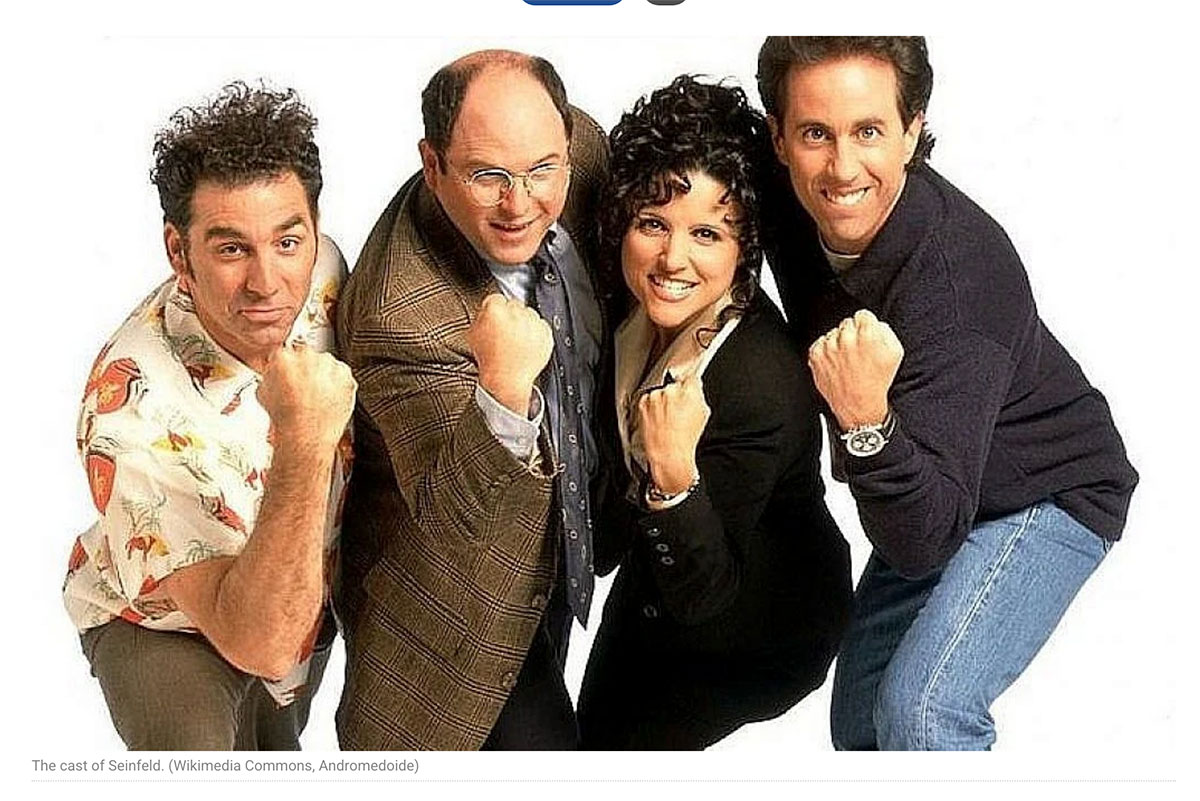
At my grandmother’s house one day, Ken turned the TV to Seinfeld. I had heard of the show, but my TV date calendar was booked. Besides, none of my friends were watching it. I was surprised to see a man so deep into Black Nationalist, or more precisely Black-male, politics watch a show with only a fleeting appearance of Black folk. So I addressed him about it:
“Why are you watching this?” I asked, point blank. He took it as the accusation that it was.
“This is Seinfeld.” He replied defensively, turning away from the show to face me. “You should watch it.”
“It’s so white.” I muttered.
“That doesn’t mean it’s not good.” He said, cutting his eyes at me, and then returning his attention to the show.
So I watched it. And like many people who watched it, I became a fan almost instantly. Within months, me and my brother would be quoting George Costanza lines at one another.
I liked the premise. A show about nothing. Just a bunch of early middle-aged white people getting up to stuff that ranged from childish or foolish, to reprehensible.
To watch it now, though, I realize the stated premise is misleading. The show is not about nothing. The show is, in fact, about the cockcrow of the fuckboy era.
* * *
The term fuckboy, as I explained previously, saw its usage explode between the 2000s and 2010s. Since then, Black male entertainers, and especially gangsta-bling rappers, have been some of its biggest megaphones, spewing and celebrating fuckboy principles.
But of course, terms like this are invented to describe a behavior that’s already in progress. So as I set out to determine why and how some men were becoming these lamentable tools, I reasoned that someone, somewhere, had observed it. Or even started it. And they probably were proud to record their achievement.
I hit paydirt almost immediately. In men’s magazines, and centrally Playboy, I found how and why fuckboyism launched: fuckboyism arose among disaffected white men in response to the perceived gains of feminism.
Playboy it seems, was white men’s central anti-feminist retreat. Too often, it’s treated as little more than T&A on display. In fact, Playboy was a home-base not just for what’s good and right with sexy pliant women, but also for discussing women deemed disgusting and horrible. It gave men a course-correction, a way to change their behavior toward “bad women” in retaliation for their failing to live up to the feminine ideal.
That is, Playboy was integral to the creation of fuckboyism. It did this using three strategies. First, it explained the origins of romance. Consider the fact that most women, then and now, think “love” and “romance” are synonymous. But the editors of Playboy knew better. And so they’d tell men what romance was, and why vulgar women (gold-digging/feminists/careerists) were unworthy of it.
William Iversen, one of Hef’s most reliable contributors and author of the book The Pious Pornographers (itself a lampooning of the oversexed content of women’s magazines), offered a brief history lesson. The “Romantic Ideal,” he begins, “is a masculine creation..” In this way, men and not women were the true romantics. The “very concepts of romantic love and devotion…have been sung and celebrated by male poets, novelists, composers and playwrights for at least 600 years” he says. In this sense, men are of course, under normal circumstances, in favor of romance.
But the feminist age does not count as normal circumstances. When the world is operating as it should with two genders of people knowing their place, women will support a man. They will lift him to greatness with their tender and unassuming natures. But now, even though American men would like to continue to court women using the rules of romance, and to “gallantly marry for love…” their aims are thwarted by the “American girl” who views marriage less as a merger, and more like a hostile takeover. These women demand to know the balance of a man’s bank account before even engaging the question of a date, since now “the female notion of connubial bliss is largely one of expanding consumer satisfactions, whether of goods, services, style [or] status.”
I don’t have to tell you that this indexes some serious anxiety about men’s ability to continue hold the economic reins, which has always been an important way men hold power over women. Could they keep women subordinate if men weren’t the sole providers? Seemingly not. Worse yet, when women have their own economic prospects, they may be less interested in just any old man willing to offer a commitment.
Instead of being proper women, then, too many had become gold-digging/feminists/careerists. In spite of the obvious differences in these types, they were all be dumped into a dustbin of “bad women” unworthy of romance or commitment. All they wanted, it seemed, was a diamond ring big enough to blind their girlfriends.
Which brings us to the second strategy: Opt for no-strings sex instead of commitment. Per Iversen, since “feministic propaganda” was converting women from sweet things into auditors, men might best avoid these bad women all together. Instead of trying to romantically court many women in search of a future wife, men should save their energy and their feelings. Rather, let men engage in their “natural inclination towards polygamous sexual activity.”
The women eligible for this should be young, hot, and eager to get it on. As another author suggests, look for women who are “trim.” Women who betray a “[f]rank and untroubled acceptance of her role as a woman,” which includes mastering “the art of pleasing men.”
The third strategy seals the deal. If a man does decide to settle down, it can’t be with any of these loud-mouthed, money-grubbing, battle axes. The court-able, marriageable woman should be young, thin, and otherwise white hot like the idealized women they’d hope to get down with. But in order to be wife material, she’d need to be selfless. The woman should put her man’s needs before her own. This woman is a “good girl.” She is also “a giver, a lavisher.”
These are the three primary tenets of fuckboyism: understand what romance is & don’t romantically court bad women, get as much of the good-good as you can and generally avoid commitment, but if you choose marriage, do it with a lithe little sex-kitten who will put a man’s needs above her own.
Fuckboyism on parade.
* * *
But, you may be thinking, these articles are from the 60s. What does that have to do with fuckboyism today? Or Seinfeld??
According to a 2017 article by The New York Times, Playboy invented modern masculinity. It had tremendous culture power. Playboy, in case you don’t know, is regularly considered the most popular men’s magazine of all time. Worldwide. At its peak, it sold between 5-7 million copies per month. That’s in the ballpark of 60-85 million copies per year. And, that’s an undercount of the actual number of men who read these rags. I don’t have to tell you that Playboy magazines used to be passed around more than a joint backstage at a Snoop concert.
It just so happens that the peak of Playboy (~1970s) coincided with the dawn of a new age. The age of the “man shortage.” Suddenly, right as the Boomers were reaching a marriageable age, all the marriageable men were gone! What the hell happened to all the men?! Ebony reported on it first as a “Black man shortage.” But by the early-80s, The New York Times claimed (white) men were suddenly unwilling to initiate partnerships.
So, there’s the lack of commitment. But by the 1990s, the other two elements: wanting the kind of relationships we now call “situationships,” and appearing to be pretty well intent on getting a tall, thin, white woman in their choice of partner, were evident.
Candace Bushnell—yes, that Candace Bushnell—published in 1996 (coinciding with the Seinfeld era) that juggernaut, Sex and the City. Don’t be fooled. The book and the show are very, very different. The book is a chronicle of what she describes as “the end of love” in Manhattan (where Seinfeld takes place) in the 90s. What she describes as “Love vs. The Deal.” White middle-and-upper-class men there would regularly forego a banal kind of love affair, preferring to pursue models and have endless affairs with other women that were going absolutely nowhere. The men she met told her things like, “I want beauty. I have to be with a beautiful woman.” About this dastardly situation (read: our current situation) Bushnell surmises,
Bushnell is like a descendant of Betty Friedan. She was describing the *new Problem with No Name. But instead of being the emptiness white women felt inside about being housebound, it described the white men who refused to commit to women, even women they might love (!), if the women didn’t meet standards previously articulated in Playboy.
* * *
I still love referencing Seinfeld. It’s an important cultural touchstone. Only now, I can’t help but to notice all the fuckboy antics of Jerry and George. Watch it now and notice how Jerry notoriously pursues models or women who might pass for one. He has one relationship after another with no hope of anything deep developing.
George goes out of his way manipulate women to get what he wants. In the episode on “hand,” he is thrilled to make girlfriend desperate to figure out the best way to please him—before she grows wise to the con and dumps him.
And of course, their biggest fuckboy antics? Their emotional immaturity. They do not want to be honest with women about their feelings. There is no such thing as romance or courtship. We don’t see Jerry thinking much about commitment, and George is saved from commitment by his fiancé dying while preparing the wedding invitations.
No, Seinfeld is not about “nothing.” It’s in large part about the new era of relationships between men and women. A great deal of it is about fuckboyism—we just didn’t have a name for it yet. Consider the irony: most white male Boomers have never heard of the term used to describe the behavior their generation innovated.
Learn more about the role of porn and white male discontent in creating fuckboyism in my latest book, The End of Love: Racism, Sexism, and the Death of Romance.