
The New Black (& Male) Sellouts Part II
February 26, 2026
The Obesity Epidemic’s Dirty Underwear
March 12, 2026The New Black (& Male) Sellouts Part II
February 26, 2026The Obesity Epidemic’s Dirty Underwear
March 12, 2026Don't Get Too Big, Gurl
If you’ve ever heard me describe how I came to my research on fatphobia, you’ll know that a lightbulb went off for me at the age of 22. This was years after my grandmother kept trying to pull me into conversations about it. But you might not know that at that time, I myself was shamed for being fat.
I was working as a researcher at an HIV medication adherence clinic in San Francisco Bayview Hunter’s Point, at that time a predominately Black and Latine area of the city. The clinic also had a needle exchange program. We kept a bounty of sweet snacks for our clients—which we’d often help ourselves to—since sugar is a vice deemed lesser than (but a salve for) heroin addiction.
Every day for lunch, I’d order a soul food plate from Mozell’s, or a full-works chicken burrito from the local Mexican joint. This would be followed by a mid-afternoon brownie, or if I was feeling fancy, some peach cobbler. I gained 25 pounds. This was 25 pounds on top of the Freshman 15. So, at the age of 22, I weighed 40 pounds more than I had at the age of 18.
In many respects I thought I looked freakin’ amazing. I’d always been a relatively slender person. On the one hand, that had made me feel like I wasn’t too far away from being a fashion model, and so I didn’t fall outside the mainstream norms of beauty and thus respectability for a young woman. On the other, I knew full well that where I came from, being thin was not where it was at. Add my deep brown skin and thick, kinky hair to the equation and I could be pretty sure growing up that the boys I knew were going to look right through me, searching for stacked girls with longer, straighter hair, and lighter skin.
I’d reached a size 10. That black male catnip. At the time, I kept my shoulder-length hair in a perm, and my newly D-cup breasts smashed into a too small bra. I never had so many black men tryna holla at me. One tracked me down on the street, breathless, just to tell me how beautiful I was. It was the sexual validation I’d always wanted.
Still, I did struggle internally at times about being thicc. I had inadvertently traded the thumbs up from the largely white mainstream, for more likes from cis-het men of color. It’s the no-win Faustian deal that underlies women’s desire to meet the standards of our own objectification.
Around that same time, I was training for a triathlon. I was working out in a team of men and women for 6-7 hours per week—not to mention my solo runs. One of the white women I was training with once told me, “you have such a pretty face, if you could just…” she trailed off. I knew what she was getting at. If I could just lose weight. Then, I’d be a real knockout.
I was trapped between two worlds. Back at work, more than once, I was caught standing in front of the office window that projected a slenderizing image, trying to convince myself that that was the real me. More than once the black man whose office was just beyond the glass poked his head out, concerned. He never said anything, probably because he had no idea what the hell I was doing. And anyway, I was working in an environment in which everybody could be labeled thicc and thiccer. This meant that for the most part, nobody really said anything.
Until Sheryl did. Sheryl was a black woman in her late 40s who had the kind of ass you could rest a cup on. She was also the office clown. She told this story one time about a seeing a drug dealer strike a drug-addicted homeless man near the office.
“I mean, he reached back...” she mimed his motions, bringing her arm back and his swinging it forward with velocity. “…and slapped that crack-head off his feet!” Then she mimicked the man tipping back and falling down, eyes rolled back in his skull.
Her reenactment leveled the room. The man was someone who could have been one of our clients. But the way she told the story was so animated, it somehow triggered the kill switch on what should have been our collective empathy.
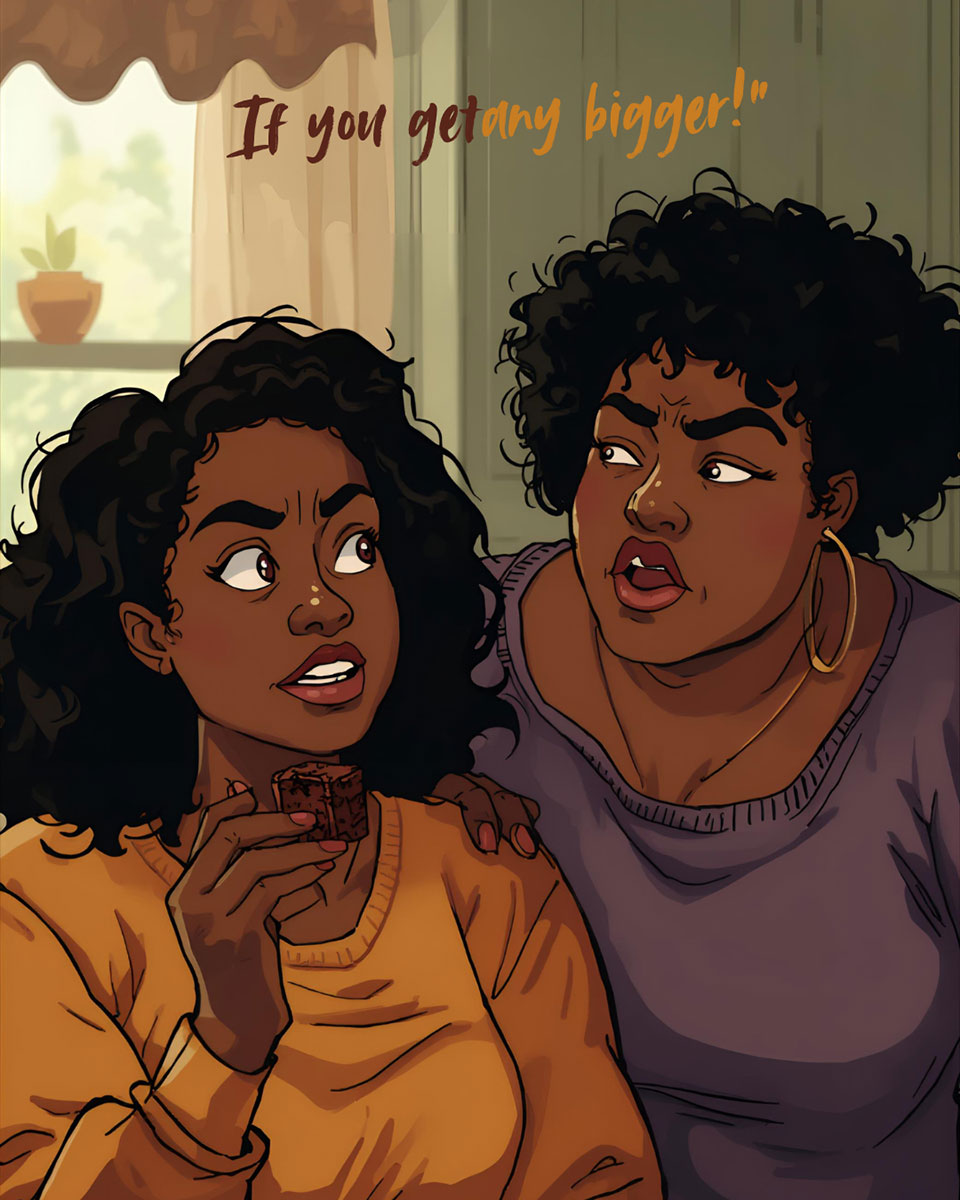
One day, Sheryl was in the kitchen when I was getting my routine 3pm brownie. She lowered her head reproachfully, shaking it just so. She lifted her eyes and said, “Girl, if you get annnyyy bigger.” She pursed her lips.
In addition to having a shelf ass, Sheryl was heavier than me. Her thiccness was, without a doubt, a source of pride. That, and the fact that she had a reputation for being able to burn in the kitchen, meant that she was real popular with the menfolk.
“What?” I asked.
Her reply was a smooth,
“You heard me.” She grabbed her own snack, before turning to walk out of the kitchen.
It was a small comment, stated without preamble or follow up. I spent the rest of the afternoon trying to wrap my mind around how someone thiccer than me had got it into their head that it was a good idea to go in on body shaming. (It’s like when one Black person says to another, “Damn you Black!” like it’s an insult.) Maybe everyone had silently seen me gain this 25 pounds and Sheryl thought she might step in and say something before things got out of hand. Before I got “too big.”
* * *
In my book Fearing the Black Body, and other writings, I describe how fatphobia in the West finds its roots in anti-blackness. Effectively, since at least the 18th century, white philosophers and race scientists had been convinced that Black people were excessively “sensual.” Black Africans, they claimed, are addicted to gratifying their sexual and oral appetites. As a result, they asserted, Black people tended to be “too fat.”
This, of course, does not answer the question of what Black people thought of fatness historically, and especially fat Black women. I conducted a separate study of this (you can find it here). It turns out that in the major Black publications from the 19th-mid-20th centuries, very little discussion voluptuous, fat, or thin women appeared. When it did, it was usually positive, regardless of size.
That blew me away. I could not find the roots of the African American preference for thicc physiques, and (frequent) ridicule or disdain for fat and skinny bodies. It didn’t make these preferences any less real, of course. They didn’t simply jump, fully formed, out of Sir Mix-A-Lot’s mouth or The Commodore’s instruments.
Still, I didn’t need to consult the historical record. I understood all that I needed to know about the here and now. Nobody needed to tell me that “thicc” was good, and that “fat” and “thin” were not as good among many Black folks.
And if folks in the neighborhood weren’t up to the task, there were plenty of media representations to remind me: thicc over fat and thin. There were all the slim-thicc video vixens from every rap song you’ve ever seen. Do I even need to tell you about Baby Got Back? How the foil for Black women who were “little in the middle but got much back” were a series of anorexic-looking white women? I also remembered watching one of Martin Lawrence’s comedy specials from back in the day, as he describes how sexy it was for his girl to have gained 5 pounds, and how turned off he was when she gained 75 pounds.
So, when Sheryl warned me not to get “annnyyy biggger” we both knew what collective knowledge she was calling on.
* * *
It was around this time that I met the two women one Black, one Latina, who both refused to take their HIV meds for fear of gaining weight. In my memory, my interviews with these two women put a fine point on questions my grandmother had been asking about white women’s dieting habits. Why were they starving themselves? But I suppose neither she nor I had spent too much time reflecting on that fact that even in Black communities, there’s typically still a weight hierarchy. Voluptuous women with tig-o-bitties, geto booties, thick thighs and tiny waists are at the top. Sheryl was at the top. But temporarily thicc women like myself, who dared rapidly gain weight, were at risk of hopscotching from thicc to fat. And once you were fat, you could be subject to ridicule by folks of all races.
After I left that job, I dropped the 25 pounds as quickly as I had put them on. I moved to southern California for graduate school. Fell in love with a man of color who admired my athletic figure and was not afraid of my dark skin and my Afrocentric hair-styles. He told me that he was big into the “India Arie” look.
How rare for me to hear such a thing from a man of color; in my experience the internalized preference for light skin and straight hair meant they were, like the Black nationalist author of Soul on Ice, searching for a woman who wasn’t, or at least didn’t mostly look too Black. This is the strange half-life of anti-blackness. It spends half of its radioactive existence pummeling through white spaces. Eventually, insidiously, its poison seeps into communities of color.
It meant so much that a man desired my Black self as I was that I remained mesmerized by him despite some obvious fucked-uppedness. I hung around until the day he grabbed me by the collar, lifting me off my feet and dragging me down the hallway and into the living room, in a nearly successful attempt to throw me out of my own home, whereas, I had not auditioned to be in a Tyler Perry movie.
I walked away from that situationship. I found yoga, rediscovered meditation. I lost a further 15 pounds without trying or, I might add, wanting to. (Elna Baker already told you, this is when white men take note.)
I started seeing a Black woman therapist. She was able to help me understand the root cause of my feelings of worthlessness—and they weren’t owing to an absence of male sexual objectification. Yoga, meditation, and therapy did a great job of helping me find joy. I was no longer depressed. I made peace with my own body. I fell in love with myself.
*This is an excerpt of a piece that was originally published in 2020 on actor and activist Jameela Jamil’s I Weigh platform:
https://iweighcommunity.com/dont-get-too-big-gurl/