
Porn Invented the F*boi
January 15, 2026Porn Invented the F*boi
January 15, 2026I’ve never been much of a Barb. Back when Nicki was first hitting it big, I remember asking myself, what is the big deal? And do we need this?
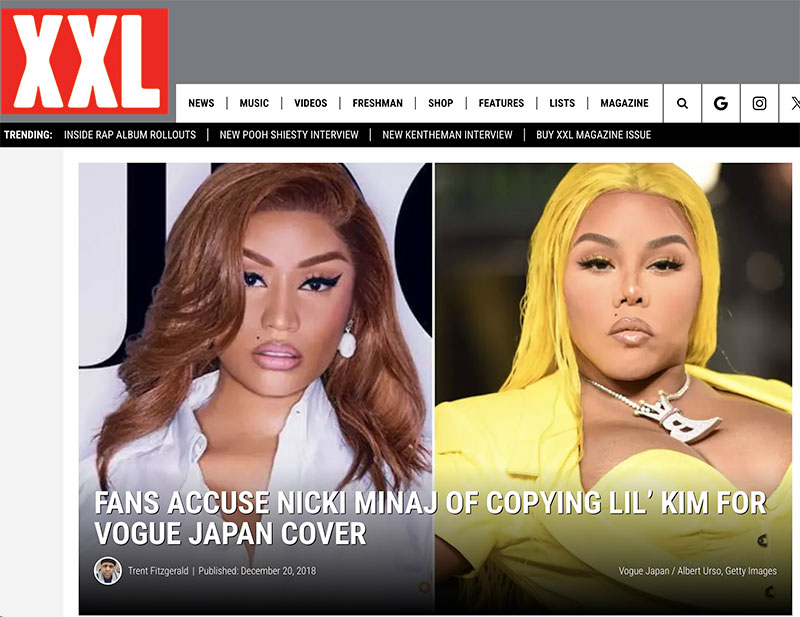
One of the more worrying aspects about her rise to fame, though, was the constant comparison to Lil’ Kim. On the surface of things, the juxtaposition makes sense. Lil’ Kim innovated an aesthetic she labeled “Black Barbie” back in the early 00s, as flaunted on her 2003 hit, “The Jump Off” ft. Mr. Cheeks. Around then, she made a bunch of changes to her appearance, like getting implants, wearing a variety of bright colored wigs (favoring blonde and pink), shaving a piece off her nose, and lightening her skin.
Nicki, a former friend and acolyte turned rival, went through a belated, nearly identical transformation. She starting calling herself “Harajuku Barbie” some six years after Kim laid claim to the Black version. And Nicki, of course, calls her fans “Barbz.”
But there’s more to the question of their presumptive similarity than who gets to be the reigning plasticized rap queen, claiming the Michael Jackson Award for Best Visual Ethnic Transformation. There’s also the politics of the music. Lyrically and sonically, Kim was always raw. Nicki, on the other hand, has long been conservative.
The hard truth about contemporary commercial rappers is that many, if not most of them, have long been repping (white) conservatism.
As I explained in an earlier post, hip hop grew out of the angst and anger young Black and Brown men felt at the tail-end of the Civil Rights Movement. With promises left unfulfilled despite the mantra of change—especially coming from the Democratic party—many youths took to thuggery and banging. It took a handful of intrepid gangsters, tired of the death and destruction, to broker peace on the eve of an all-out war.
What these youths experienced next was a certain type of ecstasy. It was not uncommon to see whole blocks lit up with the revived spirit of a groove. The gangs became DJ crews. They created a new form of music, with mixes, drum beats, and record scratches to make a whole generation—Gen X—catch the boogie. Because before anyone ever spoke of “rapping,” the DJs were gods.
In those days, roughly the mid-70s through the mid-80s, DJs drifted through New York City's boroughs like superstars. None were more famous than Clive Campbell, better known as DJ Kool Herc. On any given day of the week, Herc could be seen gliding through the Bronx in his 1966 drop-top Pontiac Bonneville, with two of the biggest speakers you’ve ever seen in your life squatting in the backseat.
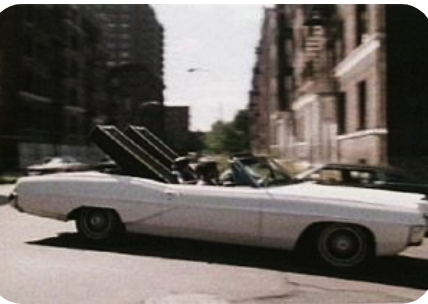
DJ Kool Herc circa 1970
But for all of Herc’s fame, his DJ sets were rarely recorded. Which means most have not been saved for posterity. Laying down tracks came largely with MC-ing.
Of the four elements of hip hop—breaking, graffiti, DJ-ing and MC-ing—MC-ing was the last to take off. Will Smith reflected on this on his podcast, Class of ’88, where he recalls his low-key giddiness at meeting Jazzy Jeff. Jeff was an established DJ, who was coming off his win at the 1986 DJ Battle for World Supremacy. To hear Will tell it, he was originally Jeff’s hype man, which explains why he comes second in duo’s name, DJ Jazzy Jeff & The Fresh Prince.
By the late-70s, MC-ing, or rapping, was gaining attention. The gangs-cum-DJ-crews transformed the ever-present spirit of competition into something new: the cipher. Who was best at rocking the mic?
Often, rappers would do battle in groups—our crew vs. yours. It was a reinvention of the 19th century Afro-American tradition of “playing the dozens.” The goal was to cut the opponent down, verbally. Doing so as a crew meant more harmonized and rhythmic digs, delivered to get the most “oooohs” and “aaahhhhs.”
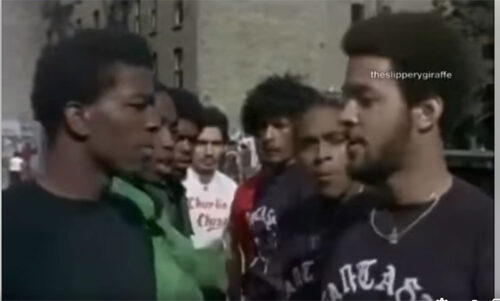
A still from the infamous battle between the Cold Crush Brothers and the Fantastic Five, 1981
Battles, or beefs, have been at the heart of the genre ever since. Often, though not always, a beef will develop when one rapper accuses another of taking a bite out of their style, as was the case with Kool Moe Dee and LL Cool J. If you’re too young to remember that beef, you might know about Ice Cube vs. N.W.A. You’ll no doubt remember Kendrick and Drake, Nicki Minaj and Cardi B, and of course, Nicki Nick and Lil’ Kim. (Honorable mention to Eminem and Mariah Carey, because even though she doesn’t rap, she actually obliterated Eminem on “Obsessed.”)
Controversy sells, and there’s no doubt that these beefs helped propel rap to the top of the charts. But, there was another aspect of the genre that was also there since the beginning: the politics of the movement era. The ideas about collective liberation that originally captured the imagination of the young and motivated.
When rap launched, it was about partying, battling, and speaking truth to power. On that last note, consider the 1982 jam “The Message” by Grandmaster Flash and the Furious 5. The lyrics were a reminder of the racism and classism still pulsating through American ghettos. The video has a documentary feel to it. In it, the rappers document the lack of jobs, education, other opportunities to thrive in the hood. The video even ends with the band members being arrested.
This was serious political commentary. It propelled the band up the Billboard Charts, especially what was then known as the Hot Black Singles Chart (Yikes!), which was later rechristened the Hot R&B/Hip-Hop Charts. It was only the second rap single ever to chart.
Partying and battling, those still move units. But radicalism? That began to die down when the racks began to pile up. Radicalism is often antithetical to grabbing handfuls of cash, especially when the people paying you are those in positions of power and authority. As I’ve already told you, ~70% of rap fans since the genre exploded have been white.
But guess what powerful people might like in a white supremacy? Black degradation. Songs about shooting rivals (e.g. taking the battle back to street violence), and using Black women like tissues (a reminder that Black women in a white supremacy are seen as disposable “Jezebels”) have been extraordinarily profitable, and therefore common. Google top rap songs and the three tracks that come up feature battles, partying, and sex, but not one of them has anything to do with the Black Radical Tradition that helped birth the genre.
* * *
So yah, Nicki Minaj is conservative because, in general, that draws the dollar out. Did you know that after she started to cape for Trump, joining the gang (lol) at Turning Point USA, her record sales blew up? Sales of her song “My Life” from Pink Friday 2 surged 44,000%. What’s a few million IG followers when a record can chart long after its initial release?
And of course, she’s not the only rap booster for traditional American values. Consider Snoop. His sonic verve is undeniable. But what exactly in Snoop’s lyrical oeuvre could be considered “radical”?
Just a few months ago, Snoop was called out for homophobia. It was not the first time his ass got scorched for homophobic content. But this time the controversy threatened to hurt sales. So in a reversal that took only two months, he decided to feature gay couples in a new song. I don’t know if anyone thinks this is genuine, but since conservatives have begun pulling away from homophobia, rappers have had to change it up. Cha-ching!
When anti-gay sentiment was still popular amongst American traditionalists, Jay-Z, Diddy, Eminem, Drake, Kanye, and Lil’ Wayne were all part of the notorious “No Homo” club. These are some of the most revered rappers in history. The gang seems to have disbanded only in the past decade or so, as homophobia has steadily moved from being politically conservative, to socially and financially untenable.
* * *
Some years ago, I tried to get a paper published in which I called Nicki Minaj “bourgeois.” The (Black) reviewer was outraged. Nicki grew up poor! Not every academic has a firm grasp of terms like “bourgeois,” which is not exclusively about money. It’s also about values.
Minaj and Kim are both mainstream artists. But, by the time Nicki entered the game, there was a lot more money in rap than when Kim started. And if you look beyond the surface, you'll notice their different politics.
Minaj was always more traditional with her musical concerns. She actually had a fairy godmother with a British accent, and wanted nothing more than to marry Drake in “Moment for Life.” Lil’ Kim, on the other hand, has been an uncompromising, if firmly hetero, sex radical. She describes all the ways a man ought to please her sexually if he hopes to “get her feelings in it.” And you should know that Lil' Kim has met Trump and found him personable. But recently affirmed that she does not condone a lot of the things he's done as president.
Your fave rapper might just be conservative. Everybody was outraged when Kanye, during his blond ambition phase, showed up at Trump tower with a glowing endorsement. But how closely have people clocked all the other rappers? Lil' Wayne tweeted about the wonderful meeting he had with Trump in 2020. Snoop, Nelly, Soulja Boy, and Rick Ross all performed at Trump's pre-inauguration ball. Kodak Black spit actual bars showing his love after Trump granted him presidential clemency. And Ice Cube supported his 2020 campaign. Don’t be surprised if your fave rapper joins the growing roster of MCs on Trump’s team--if they aren't already on it.
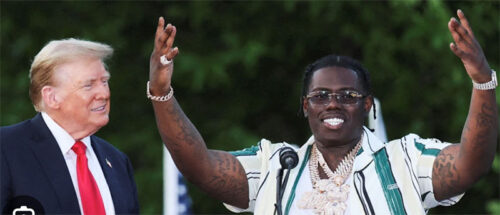
Donald Trump with rapper Sheff G, 2024
I’ll leave you with one last thing to think about:
Last year, in one of my final courses as a professor, I was teaching about rap. I asked the students “who’s heard of N.W.A.?” 100% of them raised their hands. I asked them “who’s heard of Public Enemy?” None of them had. In case you were wondering, this was a Black Studies course.
As Black people, we can’t expect young people to share values we ourselves don’t hold dear. That we don’t work to instill in them. While we’re steady clapping over a trap beat, ignoring the lyrics, they might be hearing a real conservative message.
Learn more about the radical history of, and conservative turn in rap music in my latest book, The End of Love: Racism, Sexism, and the Death of Romance.