The New Black (& Male) Sellouts
February 19, 2026The New Black (& Male) Sellouts
February 19, 2026The New Black (& Male) Sellouts:
Part II, Snow Bunnies
I wasn’t always a fan of Mike Epps. When the original Friday hit theaters, I saw that movie at the budget Academy theaters in Pasadena with everybody I knew. It became a go-to activity for catching up with junior high homies who went to a different high school, like:
Hey gurl! Where you been? Have you seen Friday yet?
I’m not sure how many times I saw it at that little theater, because it stayed there for months. And you cannot beat a $2 movie with a Black cast, and Black audience. No sir!
I don’t have to explain to you all the things there are to love about the movie. But for me, the biggest draw was Chris Tucker. His smooth chocolate skin. His large bright eyes. His amazing talent for physical comedy. I watched the original as many times as I could as I waited on the sequel.
When they brought the movie back with Mike Epps, I was like Who is this clown! How could they make a Friday without the funniest person in the original? I almost couldn’t bring myself to watch it.
It took the release of All About the Benjamins for me to appreciate Mike Epps’ comedic chops. Go anywhere in Black L.A., even now, and start reciting them lotto numbers like: 15, 30, 37, 38, 45, 47. Watch every other Black person in earshot start reciting them with you.
Still, it wasn’t until his 2024 comedy special Ready to Sell Out, that I began to appreciate his genius. He takes us on a journey in this special, as he does in all of his specials. And when he arrives at the core bit, the one about selling out, he has this to say:
I’ve been acting like I don’t like white people for 40 years. I only do it in front of Black people. When Black people ain’t around, I am white.
This is a hilarious revelation, especially coming from a Black man who is a former drug addict and dealer, who has been to prison more than once. And as you can tell from his breakout roles in Friday and All About the Benjamins, he became a Black household name by playing hood characters in Black movies. How could a poor Black man, an ex-con from Indiana, famous for reppin’ street life, proudly proclaim himself to be white?
Epps explains that he’s always liked white people and apparently seen himself in them. But other Black people were preventing him from living out a normal life spent in the bosom of white folks:
Black people put pressure on you to be racist. I wasn’t even racist all this time.
This is not how the dictionary defines “racist.” Racism implies a power relationship between the people who invented the concept (i.e. white people) and those who’ve had to be subject to its rule (i.e. everyone else). While a Black person can be racist against other people of color, there are no “anti-white” aspects of the racial system for non-whites to mobilize against white people.
But that aside, Epps is pointing to something important. He’s describing a profound shift in the ways Black people, and I’d argue especially Black men, have related to the idea of what it means to be a Black person getting cozy with white people. He’s also signaling the changing face and character of the “sellout,” from white-washed middle-class striver, to hood-ass brotha on the come up.
* * *
In an earlier post, I gave the standard definition of the word “sellout,” a term dating back to slavery. Today, it’s typically described as Black person who would betray other Black people in the interest of getting some taste of white favor for themselves. This is often in the form of a financial payout. The idea is that they have sold themselves (or in some cases other Black people) to white people to turn a profit.
There’s just the slightest hint of prostitution in it, where the Black person (usually male) is a trick, and the white man is the pimp. And that’s apt. Because it turns out, sex, and not money, was at the root of its some of its earliest uses. Back in the day, “sellout” was used to castigate a Black person (usually male) who would have a sexual relationship with a white person (usually a white woman).
In a stinging irony, one of the first people known to have been excoriated for selling out by these terms was none other than famed abolitionist, Frederick Douglass. For over 40 years, Douglass had been married to a Black woman named Anna Murray. In their decades of wedlock, they welcomed and nurtured five children. But Murray moved on to the sweet hereafter in 1882. After that, in 1884, Douglass married Helen Pitts, a white woman and fellow abolitionist.
If you’re like me you’re thinking, Uhhh, wasn’t that just the kind of thing to get Black man lynched in those days? The answer, in general, is yes. But they married in Washington D.C., which at that time did not outlaw interracial nuptials.
The fact that it was legal did not stop people, both white and Black, from being outraged by their matrimony. According to Randall Kennedy, Professor of Law at Harvard University, the once beloved Black leader was swiftly denounced for this supposed betrayal. One black-owned newspaper intoned, “Fred Douglass has married a red-head white girl…. We have no further use for him. His picture [has hung] in our parlor, we will [now] hang it in the stable.” This apparently followed an old superstition that hanging a photo in a horse stall could bring bad luck, illness, or even death to the depicted.
The particular form of betrayal here was “sleeping white,” a variation on the idea of sleeping with the enemy. For much of our history, it seemed Black men have been more likely than Black women to catch hell for this so-called “racial treason.” There was the case, for example, of Jack Johnson, the world’s first Black heavyweight champion in 1908. Johnson dated and married a string of white women, before being convicted of violating the Mann Act in 1912 for transporting his white lover (as if she were white powder) across state lines.
And while these, and much worse il/legal repercussions could befall any Black man seen so much as looking at a white woman—because you haven’t forgotten about Emmett Till—this post isn’t about the white violence that erupts in the name of defending the sanctity of the white race. This post is about how Black people have responded to Black-on-white sexual affection. And if throughout much of American history Black men were more likely to be slammed as sellouts for hooking up with white women, it’s because Black men have been far more likely than Black women to pursue the affections of a white partner.
As I have explained in my book The End of Love, by the early 70s, within only a handful of years after interracial marriage was legalized across the United States, Black men were 4X as likely as Black women to marry a person of another race—most commonly white. This was happening during a period in which Black people were less likely to get married at all. That is to say, as fewer Black people were choosing marriage overall, Black men were rushing to the altar with surprising alacrity to lock it down with white women.
A central problem with interracial relationships for many Black people has been the fear that the aims of collective freedom would be thwarted by these so-called sellouts. That rather than allying themselves with the Black cause, they’d become traitors, showing their allegiance to white power and privilege at the expense of Black liberation.
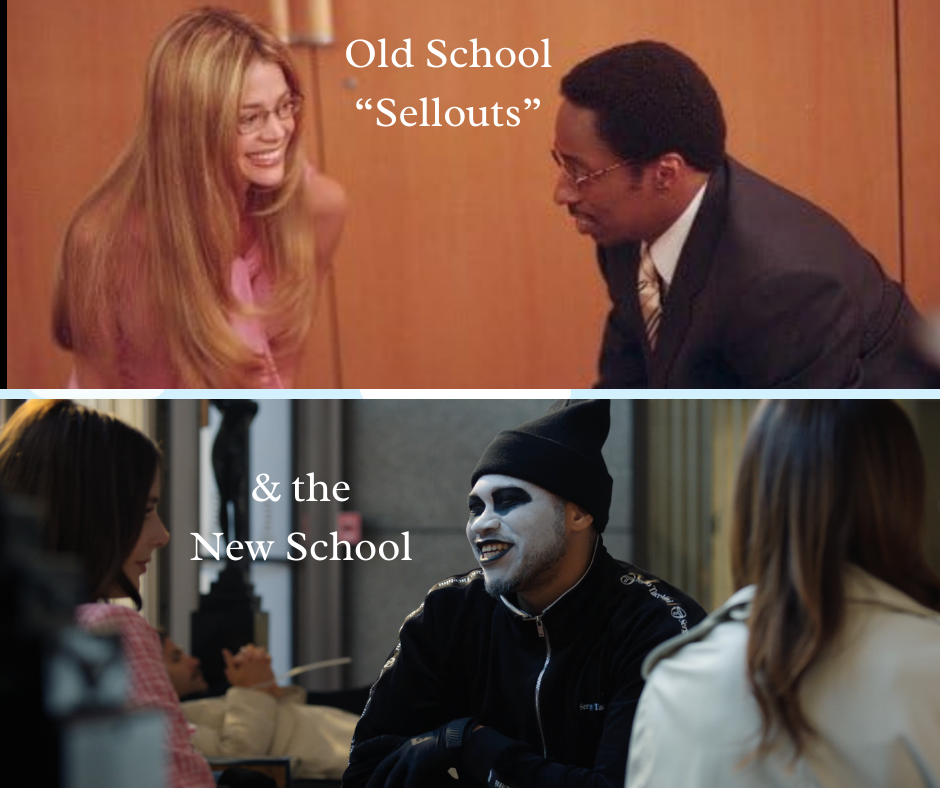
One of the most vivid representations of this comes from the aughties classic Undercover Brother. The plot centers an underground covey of agents in an all-Black justice league who have been mobilized to foil the plans of “The Man” (read: powerful white men), who’s trying to undermine the presidential campaign of a prominent Black man. In this way, the movie appears to anticipate the election of Barack Obama. But what makes the film interesting for this piece is that the lead character, Anton Jackon (played by Eddie Griffin), is thrown off course by a white female agent from “Operation Whitewash.” The agent, played by Denise Richards, is named Penelope Snow which is bad enough, but she is actually referred to as “White She Devil.”
Penelope Snow orchestrates an encounter with Anton. She bats her blue eyes and whips her blonde hair and BAM! Anton is in love. He shaves his afro. He starts drinking lattes and wearing chinos with sweater sets. AAVE is out, as are rhythmic movements, as he falls for what is described in the movie as “The Black Man’s Kryptonite.” In other words, a relationship with a white woman is depicted as turning a Black man, into a cheap sad version of a middle-class white man, who’s sold his soul (not in the spiritual but, in the Black power sense) by being with a white woman.
This was the old view of a sellout: a Black man sliding between white thighs and transforming into a counterfeit white man who’s never heard of black berries and sweet juices. It was still in circulation during many of our lifetimes. But that started to change about 15 years ago. And rappers were, again, at the forefront of the shift.
* * *
By the 2010s, something had profoundly shifted in the understanding of what it meant to be a Black man with a white woman. All of a sudden, Black men were not characterized as a selling out for being with white women. No, suddenly Black men, especially “real niggas” have redefined being with a white woman is the goal, that apex sexual flex for a Black man from the hood. This is the ironic new height of Black masculinity. And even before Mike Epps, rapper Vince Staples was pointing me towards the new contours of the game.
I was watching the Vince Staples show. In the episode “Black Business,” he goes to a bank to apply for a small business loan. While he’s there, he getting no love for being a rapper, and is about to be denied the loan. He is incensed at the racism! But then, a few of his homies just happen to storm in to rob the bank. Mid-robbery, one of them decides to put his game down hard on the white women hostages—and only them. Flashing a toothy smile and handing out IG info, this man is desperate to land one of these white women.
In another episode, Vince is talking to two Black women. These women are uncooperative. He says to them, “I hate niggas,” then storms off. Seeing all this I thought, so Black men wanna be angry at white men for being racist, and at the same time show how much they hate Black women and desire white women?!
Do I even have to tell you that I suspect this began with Ye? He began his career slamming the unfairness of life as a Black man, then turned a corner where he started devoting an incredible amount of his lyrical efforts to Kim. He refers to her as an angel, a devil, a prom queen, his love. He wants to fight Pete Davidson over her. He wants to buy the house next to hers. More than anything, he talks about her like she’s a drug, and he’s an addict, as he raps desperately and apologetically on 530 asking “who gon' break whose heart first? Always just breaks mine… I'm tryna leave you alone.”
The idea is that white women are an addictive, dangerous influence on Black men. They were like Kryptonite when seen as sapping their strength (i.e. making them look and act white). But now, they get to have white women and be “real niggas!” White women are literally likened to cocaine (or “snow”), something to make them high, to elevate their consciousness. This is part of the reason white women are often called “snow bunnies.”
The term snow bunny originally referred to someone who liked to hit the ski slopes. Now, it’s used by Black men, and especially rappers, to describe a skin tone and addictiveness (“snow”) as well as hotness (like Playboy “bunnies”). It’s not clear which rapper used this term first, but let’s consider who’s been using it lately.
In 2022, rapper NBA YoungBoy released a song “Snow Bunny” in which he brags that his girl, “she the same color as my Rolls Royce, Caucasian.” The following year, a rapper named yungcameltoe released one of his biggest songs to date, “Snow Bunny Heaven.” In it, he proclaims, “when I die, I’ma go to snow bunny heaven.” He has remix video where you can see him listing a variety of European countries, explaining that if the women aren’t from one of them, he’s not interested. According to his social media accounts, the song went viral in 2025.
It’s not just the relatively obscure rappers. Gunna brags on a snow bunny in his 2024 song, “one of wun.” Infamous rapper Future is thrilled to have “lunch time in Cheetah with snow bunny divas,” if you listen to his 2022 song “Back to the Basics.” Rappers Juicy J, Punchmade Dev, and Bootsy Collins have all released songs salivating over snow bunnies. And Tay Money, a white female rapper, has her own song reppin’ her stats as “his favorite snow bunny…I got a hundred mil’ if he say he ever dump me.”
* * *
If we believe Mike Epps, this is that new “sellout” look. Except most other “real niggas” don’t see themselves as selling out so much as glowing up. As long as a Black man still looks hood, he can otherwise be as white as he wants and still claim he’s “down.” Like that DaBaby video where Black men with gemmed-up grills take to the links to golf a few rounds. Look the street part. But love all the things white men do, including the fetish object, “snow bunnies.” Turns out that for many folks, Blackness isn’t about values or community. It’s not about love, dignity, or respect between Black people across genders. It’s about aesthetics.
Now you can understand why I’ve considered Mike Epps a genius. He opened my eyes to the new school of sellouts: Black men who are real hood and in love with whiteness. Since race science is responsible for some of the most vulgar “real nigga” stereotypes, I guess it’s a match made in snow bunny heaven.