

Black Women’s Weight Loss is NOT Reparations
December 10, 2025
Romance is for the Rich and White
December 25, 2025Black Women’s Weight Loss is NOT Reparations
December 10, 2025Romance is for the Rich and White
December 25, 2025I started watching the Diddy doc, but I couldn’t finish it. I felt disgusted. Like many people, the first time I ever even heard about Diddy getting grimy sexually was when Cassie came forward about her experience a mere 2 years ago. Now, to realize he has accusers going back to the 90s, including a woman who claims he raped her, filmed it, and then projected her assault onto a mega-screen during one of his infamous bacchanals?
And the fucking Tupac thing?!
No, I haven’t been able to get through it. But, while I was feeling the need for some 90s nostalgia, I did watch a biopic about two other notorious Black male entertainers who once owned the airwaves: Milli Vanilli.
If you aren’t at least a Millennial, you’re like, Who the hell is Milli Vanilli? Back in the day, they were a hugely popular singing-dancing pop duo. Their first song, “Girl You Know It’s True,” was released in the States in 1989. It was a mega-hit, doing numbers most new artists can only dream about, and reaching #2 on the Billboard charts. Their next three songs, “Baby, Don’t Forget My Number,” “Blame it on the Rain,” and “Girl I’m Gonna Miss You” each made it to #1.
Their debut album clocked 10 million sales worldwide, and 30 million singles sales. Those are nearly unfathomable numbers. Then, within months of the album’s release, they had won the Grammy for Best New Artist.
It’s funny now that the Grammy was for best new “artist,” because artists they may have been, but singers they were not. Yes young folks, turns out that these guys were lip syncin’ the hell out of some songs.
But this post isn’t about the controversy that roiled when the world realized these two men were not singing their own songs. For that, check the biopic. This post is about the unexpected, for me at least, realization that their first big pop hit had originally been a rap song.
“Girl You Know It’s True” was a written by the Baltimore-based rap group, Numarx. The band saw their single get its 15 minutes of fame when it was released in 1987. It was likely considered a local hit, since it moved some 100,000 units—not bad for a rap track in the late 80s.
The song was written by band member Kevin Liles when he was a teen. Talking to Angela Yee and Charlemagne in 2022, he explained that he was “16, in love,” and decided to set his feelings to music. The band never made a music video for the track. So, you can imagine his surprise and outrage when he saw one on MTV two years later, starring Milli Vanilli. The Milli Vanilli version, he claims, sold 18 million copies.
It's an incredible mountain of drama heaped onto what many of us older folx already knew about the scandal. But I couldn’t stop thinking one thing: a rap group made a song about love?!
If you’re an old person like me, you’re like, of course! LL Cool J’s discography is littered with love songs, from “I Need Love” and “Around the Way Girl,” to “Luv U Better.” Being a brown-skinned girl in a fair-skinned world, I always loved “Black Coffee” by Heavy D. And how could old skool hip-hop heads forget The Lost Boyz’s “Renee,” a tragic tale of love, aspiration, and untimely demise told poignantly by the charismatic Mr. Cheeks?
If we’re talking about other forms of love, like love of family, let’s get it with Tupac’s “Dear Mama.” When it comes to all forms of Black love, I have to mention one of my all-time favorite hip-hop albums, Black on Both Sides, by the artist then known as Mos Def, which featured the soulful tracks “Love” and “UMI Says.” And this is what UMI Says:
My Umi said shine your light on the world
(Want Black people to be free, to be free, to be free)
Shine your light for the world to see
(Want Black people to be free, to be free)
Even Drake, once considered the reigning softboy-cum-fuckboy king (at least by my dope ass UCI undergrads!), landed his first big hit with a song about how amazing his girl was: “Best I Ever Had.” He even uses the word “love” in it.
But that was 16 years ago, when many of today’s young rap fans were still tottering around in nappies. Love ain’t much of a topic in today’s rap. Google “which raps songs are about love” and find out. The vast majority of songs that Google gives you will be before 2010. Only a sprinkle appears after 2020.
It’s a shame really, because did you know that rap was a musical genre forged in love?
* * *
It began in the early 70s, the tail end of the Civil Rights Era. Urban areas across America were getting steadily deadlier. There was a deep pain and sorrow among Black and Brown youths, who had been hearing about a “progress” coming that none of them could see or touch. In the boroughs surrounding New York City, gang violence was about to detonate.
Then, on the verge of a war that would have involved dozens of street gangs, a few of their leaders, including Benjamin “Yellow Benjy” Melendez decided to put an end to the hate. He argued that instead of violence and retaliation, they should strive for peace and unity. After all, their beloved neighborhoods and relatives would be the only casualties in an all-out street war. Melendez was a key figure in brokering a peace deal among 50 rival gangs.
The irony that it was the gangbangers themselves (and not, say police) who made the streets safer should not be lost on anyone. Following years of constant beef, people were finally free to enter previously foreclosed territories. They could now make new friends, find new lovers, and create public art. There was a tremendous joy and relief at this new freedom, and the possibility for loving human connection. Former gangs transformed into music groups that would jam together, and battle one another, with poetic rhymes and turntablism. This was the birth of hip hop.
I’ve already told you about some of my favorite rap songs about love. And you know that by 2010, such songs were rare. So, what the hell happened? Where did the love go?
Love started to leak out of the equation the minute rap got rich. That largely coincided with the birth of so-called “gangsta rap,” coming from the likes of N.W.A. and Ice-T. (And, as a native Angeleno, it does steam me up that the West Coast gave us what is arguably the first musical sub-genre devoted largely to hatred, specifically misogynoir and other forms of anti-Blackness.)
To be clear, N.W.A. wasn’t the first rap group to strike it rich. Run DMC and Eric B. and Rakim made major duckets in the ’80s. But “gangsta rappers” might just have been the first to find a formula that rich white guys could really get behind. It was arguably the first, but undoubtedly the longest lasting, form of crossover rap. It is the biggest form of mainstream, commercial rap, rivalled only by the equally vacant “bling bling” rap. I mean, Dre more or less gave us the equation for success (Black degradation = more sales in white spaces) in Dre Day. And didn’t Straight Outta Compton imply this as well?
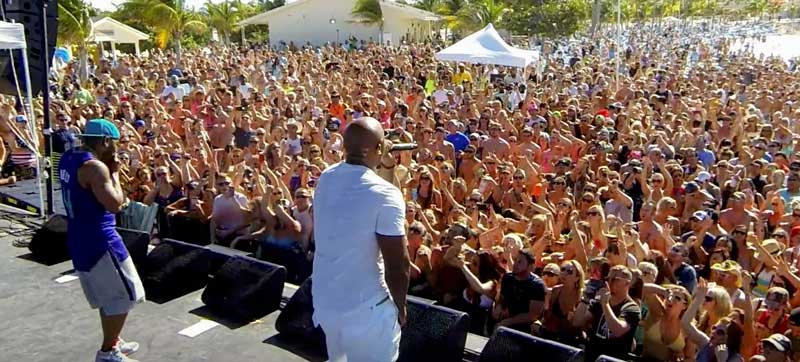
A still from Nelly’s Reality Show, Nellyville. Performing in the Bahamas (!) in front of a nearly entirely white audience.
Do I even have to tell you what mainstream, commercial rap is about today? No, you already know. It’s “get the cash by any means necessary.” It’s obscene, disrespectful (especially of Black women), lurid, sad, mean, and angry. There’s so much pain and sorrow in it. A Black man I know used to play me this song, “Weight of the World on My Shoulders” that goes something like I got the weight of the world on my shoulders—I can’t hold it. It’s indie, and I can’t remember the artist’s name. (Holla at me if you know, pls.) He describes all the ways he feels trapped being a Black man from the hood: he’s broke, his bills are piling up, he got that baby mama drama. He didn’t know how he was supposed to make it in what Grandmaster Flash and the Furious Five called “this land of milk and honey.”
It’s a familiar story. And, there’s a place to express pain. I’m doing it right now. But where’s the healing in rap? Where’s the unity? The solidarity? The stealth plan for liberation from all this? The love??
It’s all pain, anger, getting over, and biting back. It’s mostly Black male artists. It’s mostly white male consumers.
Now, even most rap songs mentioning love, are still about hate. Hell, a 17-year-old Aussie rapper named The Kid LAROI made it to #1 on the US Billboard 200 with his debut commercial mixtape. The title? F*ck Love.
So, when I saw that Milli Vanilli biopic, you can understand how after decades of gangsta-bling shit ruling the genre, I was like “a rap group? Black men? Talking about love?!”
But now I see that was my bad. I’d forgotten where we came from.
Learn more about how rap developed, and made a left turn from love and community uplift to Black (and often female) degradation, in The End of Love: Racism, Sexism, and the Death of Romance.