

Romance is for the Rich and White
December 25, 2025
Is Fuckboyism Black?
January 8, 2026Romance is for the Rich and White
December 25, 2025Is Fuckboyism Black?
January 8, 2026White Woman Godzilla
A few years ago, I decided to rewatch What’s Eating Gilbert Grape. The film, based on a Peter Hedges novel by the same name, is a coming of age drama. It tells of the daily spoils and trials of Gilbert Grape, a 20-something store clerk in a 1000-person Iowan town, played memorably by Johnny Depp.
We watch Gilbert as he tries to manage his life at work and at home, fantasizing all the while of quitting his small town. The disconnect between his duties and his dreams are eating at him. For as much as he wants to strike out on his own, he can’t, it seems, because someone has to take care of his disabled brother. But, the even bigger albatross is his fat mother.
For much of the movie, we do not see his mother Bonnie, played by actress Darlene Cates. We hear her rumbling from behind closed doors, like a monster. From the comfort of her room, she is fed large meals every day by Gilbert, who experiences the guilt of being an accomplice to what is framed as her food-and-weight crimes. But, feeding her is not the only reason he feels guilty. He also lets little kids sneak a peek of her for their personal amusement, and horror.
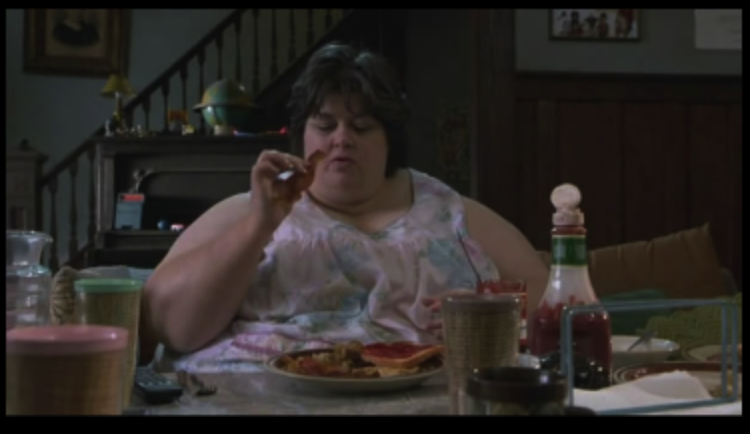
Bonnie—who was once we are told, considered among the town’s beauties, and letting that go is another one of her offenses—is presented as so heavy that she not only fails to parent her children, but in effect becomes their ward. But this isn’t the worst thing her fat has done. In the most dramatic scene of the movie, Bonnie, identified until this moment as a slurry of snarls, cackles, and clanking dishes, makes the decision to leave the house for the first time in years. She heads to the police station to collect her disabled youngest son, Arnie, played by Leo DiCaprio.
When Bonne arrives at the station, the cops quake in fear. The combination of her size and booming voice make her the kind of presence that not even the law can challenge. The police forget all about their routine policework and hand over her son. The implication is that if they don’t, this (monstrous) woman will lay waste to them all.
Watching this movie for the first time in 30 years, it occurred to me that this wasn’t, as one 2019 review claimed a movie with “heart” and “acceptance.” Neither was it, as claimed in Roger Ebert’s 1994 review, sympathetic towards the “fat mother and the...brother.”
Instead, it was White Woman Godzilla. Like the original Godzilla, a devastating event (nuclear war in Japan vs, in Bonnie’s case, the suicide of a husband and father) turns an otherwise benign being, cute and small, into a terrifying beast that strikes fear in the hearts of men. We hear about the monster before we are given a glimpse. There is no known way for law enforcement to address the magnificent creature that might neutralize it. One’s only hope for survival is to steer clear, and stand down.
But how did the specter a fat-white-woman-as-monster come to so thoroughly captivate America?
* * *
Zaftig women were once considered not just normal, but desirable. We find evidence of this within the portfolios of some of the West’s most revered artists. From Titian and Raphael to Albrecht Dürer and Peter Paul Rubens, women with fleshy, full, and rounded hips, thighs, arms, bellies and backsides commanded the canvas.
But fatness, like so many other things, was recalibrated by race. Launching in the late 17th century, most people believe that race science was founded on ideas of a hierarchy of people around the globe based on skin color. But this definition is incomplete. In reality, race science originated largely as a hierarchy of women. This hierarchy was based not just on skin color, but physical features including eye shape, lip size, nose spread and hair texture. By the 18th century, body size was also considered a visible mark of racial standing. So-called race scientists argued that white people (and especially white women) were naturally self-controlled, disciplined, and thin, whereas Black people (and centrally Black women) were innately animalistic, avaricious, and fat. It triggered a new body horror centering fat Black women, and it was not uncommon to see well-heeled white folks reeling in terror when confronted with what was deemed this “perfect specimen of Africanity.”
This is to say that fatness was linked to Black femininity at the very moment the identity was being tied to abjection. White women, as far as the historical record shows, scarcely resisted these associations. Black feminist icons have shown that race science gave white women more power and a new pride of place. No longer relegated to the unfavorable title of “the weaker sex,” they could now boast qualities of “the superior race.” Many of their chests swelled at the new honor.
The reality was of course that fat people are in every community. They exist in all genders, nationalities, creeds and of course, races. So arguably since the 18th century, white women—although of course not only them—have been at pains to keep their status high by keeping their weight low. The contortions it requires are endless.
And so it transpired that by the 20th century, white men—and especially white male doctors—began to question white women’s increasingly uncontained largess. By the 1940s, their fatness was deemed the result of a mental disorder. Lay people argued fat folks hadn’t learned the self-control of grown-ups. Psychiatrists suggested their presumptive uninhibited eating was way of soothing their inner traumatized child—or a corruption of their sexual impulse. All of these made them subjects of scorn and ridicule, but not fear.
So where did the fear come in? In my early research into this question, that of the terror suddenly stoked by fat white women, I’ve landed on two main culprits. The first was anti-feminism. You’ve no doubt heard of the stereotype of feminists as course, fat, and “mannish” that was popularized in the early 20th century, coinciding with the first wave of feminism. This idea was taken to altogether new heights with the second wave. Partially because it coincided with the birth of fat activism, in which women and especially white women, figured prominently.
These women were often uncompromising in their demand for dignity in every place and space. Many straight-sized folks, and especially straight men, took to the press to express their ire. The pages of men’s magazines contained an intergenerational disgust—and fear—with these white women who refused to be pliant, quiet, attractive and slim—the stereotype of natural and admirable white femininity. The men writing for Playboy were particularly likely to express the paranoid fear that feminists—commonly depicted as fat and white—were trying to usurp masculinity. That America as they knew it was ending, as these gross feminists converted it into a bastion of thoroughly boner eroding, big, loud, and frightful women.

A gif from the 80s hit sitcom Married...with Children. Al Bundy, a so-called everyday straight man, being harangued by fat, mostly white, women activists at work.
The second culprit was the rise in talk about “obesity.” Because of the slimness requirement impacting women, when doctors decided to place obesity on the list of prioritized medical conditions in the 70s and 80s, they wanted to clarify that women ought to be thinner than men. For years, they had been relying on insurance company tables that presented “desirable” weights for women that were below those recommended for men of the same height.
When bandying their new tool, BMI, to determine obesity, they thought it critical at first to have different thresholds for being “too big” for women and men. In 1985, the US Department of Health, Education and Welfare (HEW) claimed women (and these studies almost exclusively concerned themselves with white persons) with a BMI of 25 were obese. For men the benchmark was a BMI of 26. They of course did not and cannot provide a scientific reasoning for this. They did however suggest that the people (more of whom would have been women given the BMI bias) who defiantly refused to meet the new standard for a “healthy body” were a threat to themselves, their families, and to the public health.
* * *
What’s Eating Gilbert Grape, or White Woman Godzilla, hit American theaters just as the medical field was in the throes of adjudicating concerns about the supposed threat of obesity. It came after decades of anti-feminists—many, but not all of them men—working their own angle against full-bodied and “mannish” white feminists. Is there any wonder that a movie ginning up fears of a poor white woman whose fatness—long racialized as non-white, and thus decidedly inappropriate for white women—terrorized a small town could have been received with such delicious praise?
For when fatness was deemed "Black" many white people retreated to their communities. Several wrote about it as evidence of what was pathological about the "inferior races." But by the 20th century, it was all too obvious that this racialization was a fiction. Fatness was not outside of whiteness. And if this was a lie, what was there to uphold the entire yarn about white superiority? This realization too, it seems, helped to stoke the terror surrounding fat white women.
Not for nothing, the book the movie is based on worked as a cautionary tale within a cautionary tale. Amy, the eldest sister in the book, was described as “‘not bad looking’ but gradually eating herself into another version of her mother.” Clearly something had contaminated the water in that town. It turned white girls and women with normal and sweet sex appeal into big and barking mutants, staring down men and defying the law. Especially, it seems, natural law.