
The World’s First Black Women’s List of the Hottest White Guys
May 7, 2026
Plain Cold Ring
July 31, 2026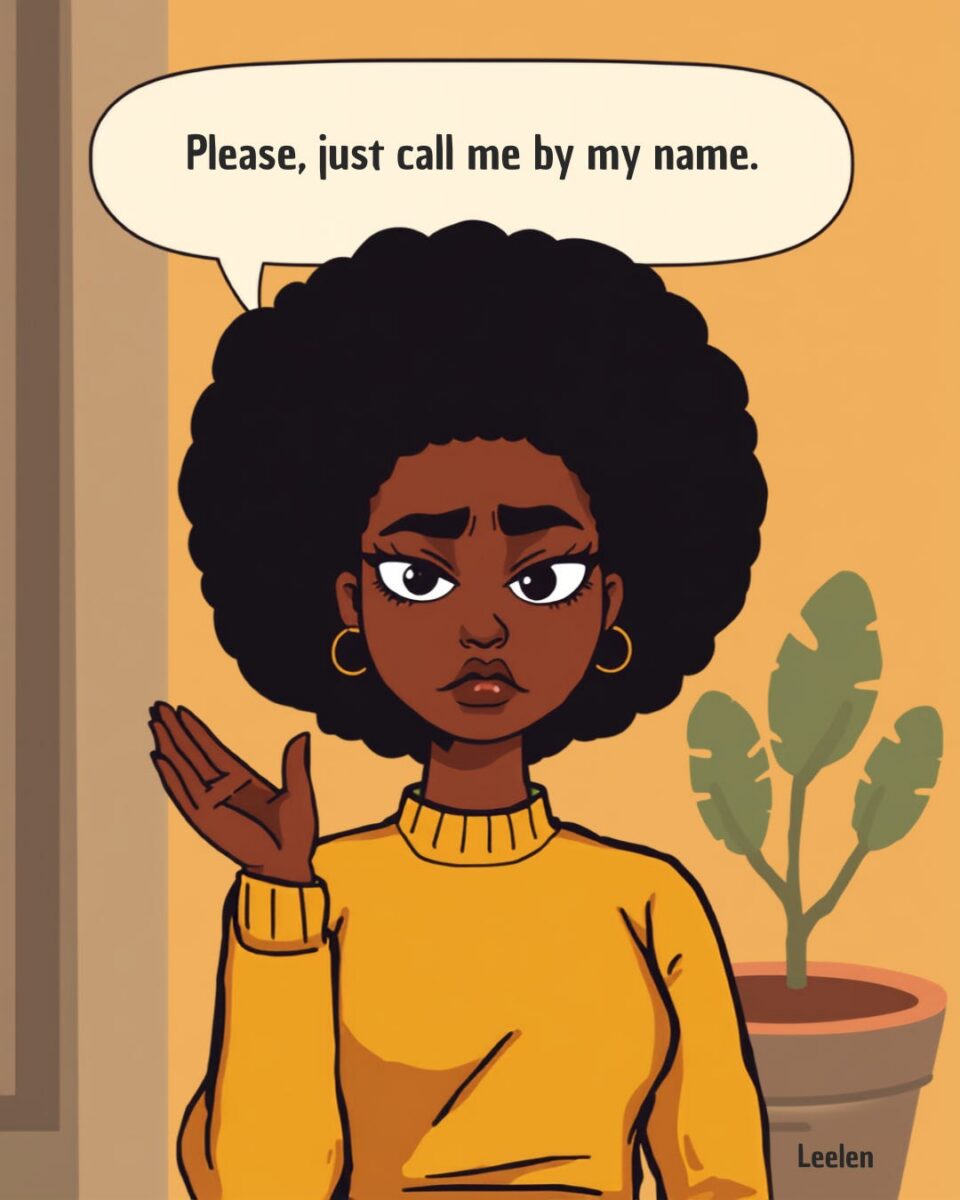
I was grieving. That’s how the whole thing started. In late 2025, I received a surprise email from a former mentor, a trailblazing Black woman sociologist. She’d emailed me to tell me I’d been selected for the 2025 Teshome H. Gabriel Distinguished Award in Africana Studies. To have an elder you admire inform you that you’ve earned a place as a “distinguished” scholar is a humbling, raw moment.
A little over one year later, I received another message, this time from her colleague: this pathbreaking Black woman, Professor Bennetta Jules-Rosette, had died. Her memorial, I was told, would coincide with this year’s gala. And would I be willing to bestow the Teshome Award on this year’s awardee, and to say a few words about my relationship to this great woman?
I felt a complex mix of emotions. I wanted to say goodbye. But, I didn’t want to be in a public cry-a-thon with former colleagues and advisors. Still, it was an honor to be asked, so I agreed on the spot.
I decided to wear a red, thick-cotton fitted-dress that hit right at the knee. It had a belt that pulled the waist, and a square neckline that gave off just a hint of boob. It was far from scandalous, and yet it was more revealing than the kind of thing I’d worn the year prior—or at any time in my days as a professor. It looked like the kind of thing a smart businesswoman would wear, and that’s what I was going for.
I rehearsed my speech at the hotel and in the car. I would tell people about the first class I ever took with her. How class started when she got there, which was well after the time listed in the course catalog. How class always began in the middle, like we were picking up a phone call that’d been cut short. And how she was more like an improv teacher than an academic. Because where most professors would “correct you,” she would always lean in, ask you to go further, tell you how insightful you were. Make you feel seen. Her classrooms were communities filled with misfits from the university margins. And she’d give what the foolish fucking objectivity-feigning academics were afraid of leaning into. She gave you her love.
It’s hard to prepare for an event while crying. You have to keep reapplying your goddamn eyeliner, and drop Systane into your eyes so you don’t look like you’re falling apart.
I had meant to arrive 30 minutes before the event, but with all that I arrived exactly as it was starting. Since I was on the program, some people had been looking for me.
“Omigod Sabrina! You’re here! Somebody was just asking about you,” said a lovely woman I’ve known for years. I didn’t know what to say so I remained silent.
She showed me to my seat. At my table was a bubbly, affable young Black woman who I’d chatted with the year prior. She was like,
“And this young lady is Sabrina Strings! She’s a full professor! Can you believe it?!”
The people at the table, not knowing me by name, were intrigued by my title. I replied like,
“Well actually, I’m no longer a professor. I quit the academy.”
With this, the oldest two table-mates immediately rescinded their interest. There were two junior adjunct faculty, however, whose mouths filled with saliva as they inquired as to why a person would do such a thing. I explained about the exploitation of women, BIPOC folks, grad students, and of course adjuncts. I could tell from their expressions that the hot goss they were seeking was about me, not the structure of the university. The things they already knew about their own precarity were not the juicy tidbits they had hoped to solicit.
The program moved quickly—something Bennetta herself would never allow. Speaker after speaker stood to honor her commitment, her tenacity, her love of what she did and those she did it with. It was a buoyant homegoing. Solemn at times, but never miserable.
I was introduced to a grad student who was surprised by what my graduation year revealed about my age.
“I would not have guessed…” she said, trailing off because there’s no polite way to finish that thought.
Before I was called to the front, someone came over to give me the run of show. I caught only every second word because he was whispering and a band was playing intermittently, and someone was speaking into a microphone. I nodded like I’d understood.
It was my time. I stood and strode fearlessly to the mic. The crowd clapped appreciatively. I introduced myself. More cheering.
I had hoped to say my piece first, then hand the award to the new recipient. But the guy was standing right behind me, waiting for his prize. So instead, I announced the award, handed it to him, and gently placed a Kente stole around his shoulders. We shook hands for the photo op. And just as I was about to grab the mic, a senior male faculty member stepped in front of me to explain why I was there, and how lovely it was to have a former winner introducing a current one. More photos, then the moment ended. I had been told I could do one of the tiny eulogies in remembrance. That I was to be given the honor of being able to honor one of my mentors.
What I got was to perform a nearly-mute pageant queen handoff. A decorative silenced role. The honor cut off at the knees.
* * *
I know and love the person who blindsided me. I understood, by the time I was in my car, that he was feeling the pressure of continuing an event solo that had been someone else’s baby. Besides, nearly everything I meant to say, someone had already said. The proof of her influence had already been laid bare. It was alright if I didn’t get to give voice to it.
The event had been catered – a served dinner and wine. But I couldn’t find any appetite for either while I was there. The moment I got on the road, I was ravenous.
I was staying at a hotel where they give you a dining credit. I decided to use it at the bar.
I sidled up to what was a surprisingly crowded scene. There were two bartenders being stretched thin, a woman and a man. The woman had given me some water when I arrived, but the guy came on after I’d left for the gala. He was standing nearer to me. He served a man and a woman who’d been there before I arrived.
The guy approached me. He was white, and looked to be in his mid-30s. He didn’t seem happy.
“What can I get you?” he asked.
“I’ll take a spritz.”
He got busy making it, while I looked around. Everyone at the bar seemed to be middle aged, likely between the ages of 35-55. Most were apparently in town for a denim convention. I felt waayy overdressed. I smiled politely, when making accidental eye contact with any one of them, then decided to keep my gaze straight ahead.
The bartender handed me my drink,
“Here you go.”
“Thanks!” I smiled, pleased that I would soon leave this awkward situation and be ensconced in the privacy of my mid-range hotel suite.
“How do you want to pay?” he asked. It’s an entirely cashless establishment.
“I’m staying in the hotel. You can charge it to my room.” I gave him the number. He seemed to register that it was one of the nicer rooms. I signed the receipt, adding the gratuity.
“Thank you, ma’am,” he shot back. His dead eyes trained on me, waiting for a response.
I cracked a side-wise grin.
“Thank you, have a good evening,” I said. He did not respond.
I knew immediately why a middle-aged white man, a man who was seemingly less than 10 years younger than me, but looked to be besting me by that much, would hit me with “ma’am.” I had watched him and the other bartender serve two men ahead of me. Neither of the men received a “sir,” which would’ve been perceived as cornily formal. Right before me he served a white woman, seemingly in her late 30s-early 40s. She received nothing but the bill.
No, I was singled out for this honor.
And of course, it wasn’t the first time. I have found that millennial men leaning towards incel living in particular like throwing that word around.
So, I started wondering about this honorific, and decided like I always do, to figure out where the hell it came from.
* * *
The first thing I found when I started researching this is that there is far less written on it than you would think. But one thing is for certain. Women have told men over, and over, and over again: Do not call us ma’am.
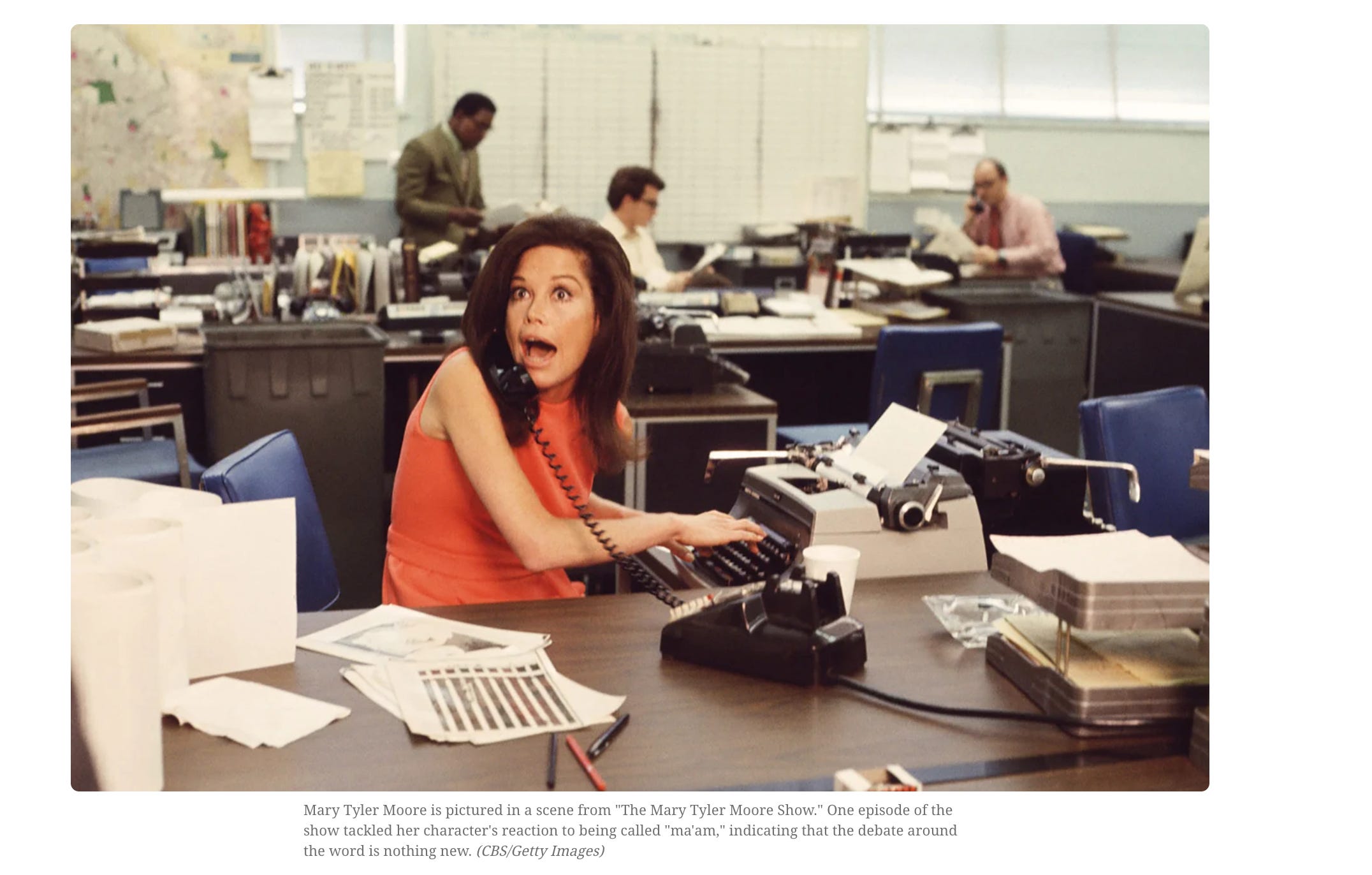
The issue is that it actually did begin as a form of honor.
“Ma’am” is a contraction of “madam,” itself a renovation from the Old French, “ma dame.” “Dame” meant dominion, as in the woman of the house. The feminine master of the domain. At that time, it bestowed honor.
The English picked it up around 1300 as “my lady.” It was a formal address for a noblewoman, a titled woman, or another woman of rank with household power. It was about authority, not age. It roughly communicated, this woman is above me, and I acknowledge her status. Many English shortened it to “ma’am” by the 1600s.
On a rung below “madam” was “mistress.” At its inception, it translated to “gentlewoman.” She didn’t have the formal title of a noblewoman. Still, she might be the wife of a substantial man, or have her own property and standing. Mistress (abbreviated Mrs.) was the female equivalent of “master” (or Mr.). Neither had anything to do with marriage. An unmarried man or woman might be a mistress/master so long as they had control over servants, apprentices, or slaves. But because the woman’s power is still within the home, there was the stickiness between mistress and madam that ultimately led to them being used interchangeably.
Then comes the surprisingly important third category: “Goodwife” or “Goody.” These were everyday married women who lacked any status tied to money or title. Goody might be a polite address, but no one would have confused a goody for a mistress, or a madam for that matter. But, they had the respect of a good Christian householder. (Goody was akin to godly.)
Notice that these terms are not just gendered politesse. These terms intentionally sort respect by rank. They were used to deliver different levels of honor based on status and money. And none whatsoever for women who didn’t at least meet the goody rung.
And the goody rung is, unexpectedly, what the entire evolution of these terms rests on. Each of these was considered a form of respect. Women without respect—that is poor women—had no titles.
But two things started the downward slide of each and every one of these terms toward dishonor:
The first, if you can believe it, was King Henry VIII trading his wife for his girlfriend. Yes, that’s right. When the King flipped Catherine the bird and hooked up with Anne Boleyn, that triggered a series of events that led to an unprecedented financial come up for Western European women who were not among the nobility.
The second, also tied to the rise of the average European women’s status is less shocking. It was the colonization of the Americas. With these two moves having been completed, a middling sort of Western European woman could—and often did—find herself with a stockpile of cash that mirrored or exceeded that of the aristocrats. And since the titles were based partly on wealth, you can imagine that these women started to expect an aristocratic level of recognition.
This was the genesis of the turn toward dishonor, specifically in the way men used the term to refer to women.
And it was in evidence already by the year 1600.
Coming soon: This story runs deeper than it seems. Stay tuned for the sequels where I explain exactly how King Henry’s philandering and Western European women’s status as new money turned ma’am from a form of honor, to ridicule.
