

What is a Cis-handed Male?
September 17, 2025
Let Men Go Sexless
November 26, 2025What is a Cis-handed Male?
September 17, 2025Let Men Go Sexless
November 26, 2025In the 1980s, music videos were born. BET hit the airwaves first, followed by MTV, and then VH1. I still remember the evening in 1987 when my entire family gathered 'round the television to watch a music video premier. We sat transfixed as a hip-swaying Michael Jackson strutted in chain mail while proclaiming he was "Bad," a commentary on the destructive nature of gang violence. And though it was already four years old, if you watched VH1 casually for more than 15 minutes, you were bound to see that same MJ kicking his foot, white sock above black loafer exposed, as he fervently denied the claim that Billie Jean was his baby mama.
By the early 90s, music videos were my lifeblood. It defined us, the so called “Gen Y.” Whenever I was at my grandmother’s house, I made sure they were on in any room I could requisition.
It seemed the 1990 EPMD video “Gold Digger” was always on. You’d walk into the room, the wood-grained technology would reveal a grainy image of a Black woman in hot pants and strapless top, bedecked with jewels, sporting a miner’s hard hat and wielding a pick axe. Flash to a disillusioned Erick or Parrish wondering how they’d ever fallen for a woman tramping for cash. Just like Ye would a decade and a half later.
Having lived through all this, it didn’t surprise me that by the 2010s, the consensus in America seemed to be that, well, Black women were gold diggers. It did surprise me, however, when I started looking into the problem, that this is a term that did not originate amongst Black people at all. White women, it seems, invented it.
* * *
It began as a bit of fun amongst friends. During the early 20th century, which is to say over 100 years ago, a dancer with the Ziegfield Follies named Kay Laurell was hanging around with American playwright, Avery Hopwood. One of Laurell’s friends walked by. Laurell addressed her friend sweetly, saying “Hello, gold digger.”
Hopwood turned to Laurell in amusement. He asked, what in the world is a gold digger? So, Laurell put up him on game,
That’s what we call ourselves!...You men capitalize on your brains, or your business ability, or your legal minds—or whatever other darned thing you happen to have! So why shouldn’t we girls capitalize what nature has given us—our good looks and ability to please and entertain men? You men don’t give something for nothing—why should we?
This was too rich a revelation for Hopwood to sit on. Already by the early 20th century, white men were getting skittish about the inroads women were making in politics and culture, not to mention the growing demand that men “treat” women to anything from meals and outings, to jewels on these newfangled events called “dates.” Now, he had evidence that for some women “dating” was a small-time con.
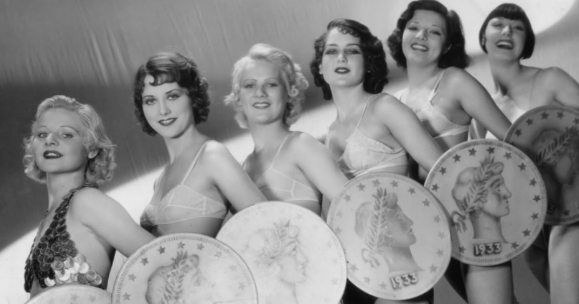
So, in 1919, the same year (white) women got the vote, Hopwood released his first play simply titled Gold Diggers. It was smashing success. Ten years later the play was optioned for the big screen. The 1929 film Gold Diggers, starring Tallulah Bankhead was another hit. But it was arguably the next rendition of The Gold Diggers of 1933 with Ginger Rogers that gave American culture it’s most unforgettable filmic version, because this one arrived with a catchy tune:
Oh, we're in the money
Come, on my honey
Let's lend it, spend it, send it rolling around
Oh boy, we're in the money
I'll say we're in the money
We've got a lot of what it takes to get along!
Of course, what it took to “get along” was being hot enough for a man to want to pay for the pleasure of your company.
An image from The Gold Diggers of 1933, showing nearly naked pretty white gals covering themselves with silver coins. An inescapable reminder of common exchange of white women’s looks and white men’s cash.
Hollywood would continue releasing films churning up the dread that hot chicks were just after the dough. This genre may have reached its apex with Marilyn Monroe’s iconic performance in the 1953 classic Gentlemen Prefer Blondes.
This is not to say films about gold diggers aren’t still being made. Only that they don’t titillate the way they once did. Lady Gaga’s and Adam Driver’s 2021 contribution House of Gucci was met with cold critics. Still, it turned a nice coin, grossing more than twice its budget.
The disconnect between what popular audiences will pay for, and what critics believe is worth spending two hours on, may explain why the most enduring and profitable medium for decimating the gold digger has not been movies at all. It’s been popular music.
* * *
Now for the uncomfortable part. Who’s responsible for making the gd gold digger a Black woman? Partly the answer is Ronald Reagan, since the gold digger picks up on the terror surrounding the “welfare queen,” the mostly mythological Black woman having babies to rack up welfare checks. But more than anyone else, it’s been us. Black people.
EPMD admitted “Gold Digger” spelled incredible success for the band. Kanye West’s “Gold Digger” was the single biggest hit of his career. Billie Jean was one of the bestselling, highest grossing songs in the career of the man known as the “King of Pop.” And though Michael didn’t come right out and say “Billie Jean” was trying pin a baby on him for the child support, did anybody think there was any other reason he pretended she was doing it? Because make no mistake, all of the songs I’ve mentioned are about fictional characters who never asked any of these men for anything.
When Black male entertainers blackened the gold digger, they made oodles, and oodles, and 000000s of dough. That’s the final irony. It is so extraordinarily profitable for Black men to claim Black women are gold diggers, that in reality it is Black men who turn an unjust profit. And the price is Black women’s reputations.
But we don’t get to play the victim. We love them jams. Damn. I still think Billie Jean is my favorite MJ song of all time.
-- Learn more about the history of the maligned gold digger in my latest book, The End of Love: Racism, Sexism, and the Death of Romance --